A system designed to make thinking reliable — not just fluent.
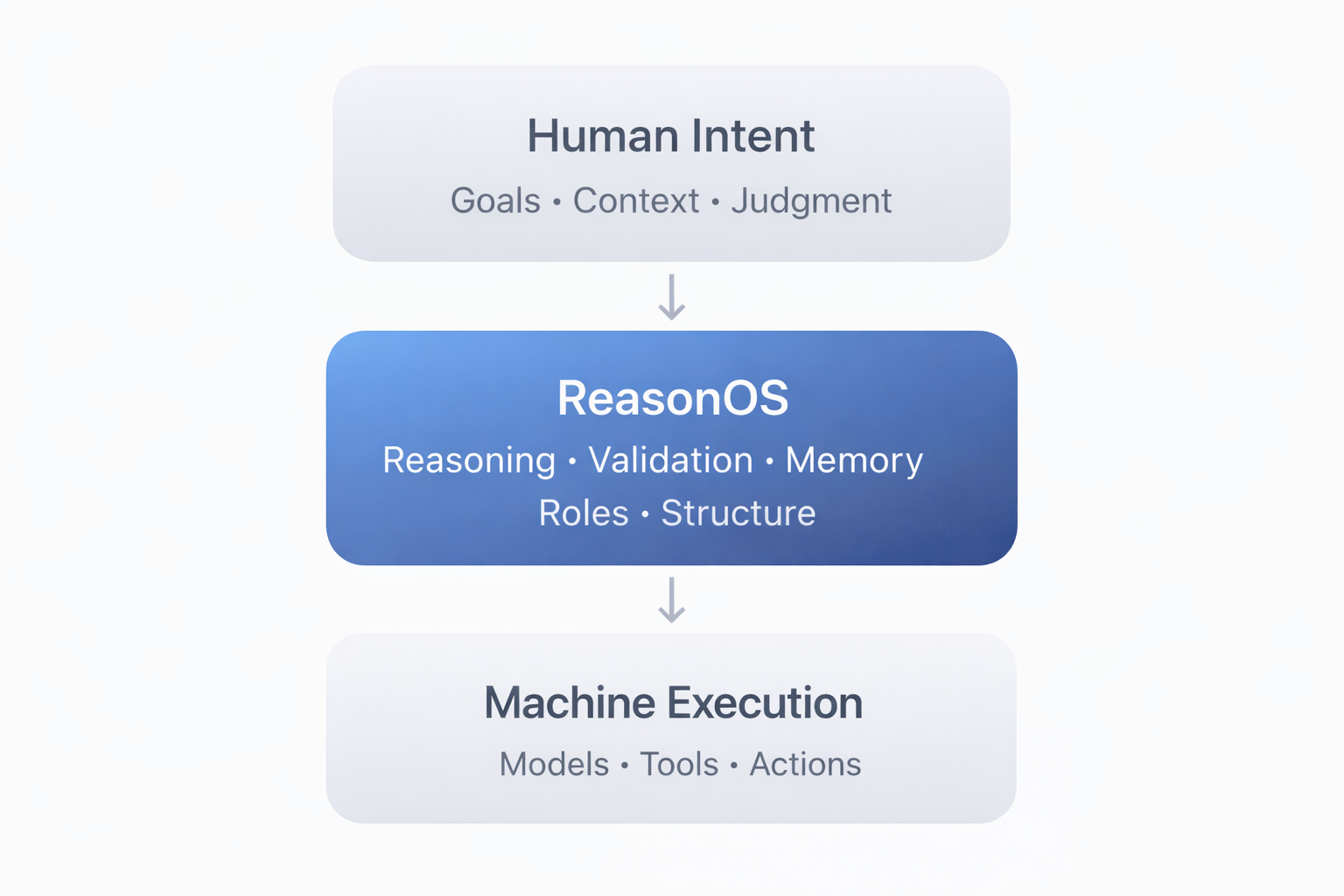
ReasonOS sits between human intent and machine execution.
It abstracts over models, retrieval systems, memory, and validation —
providing a durable reasoning layer that products can be built on.
The problem with modern AI
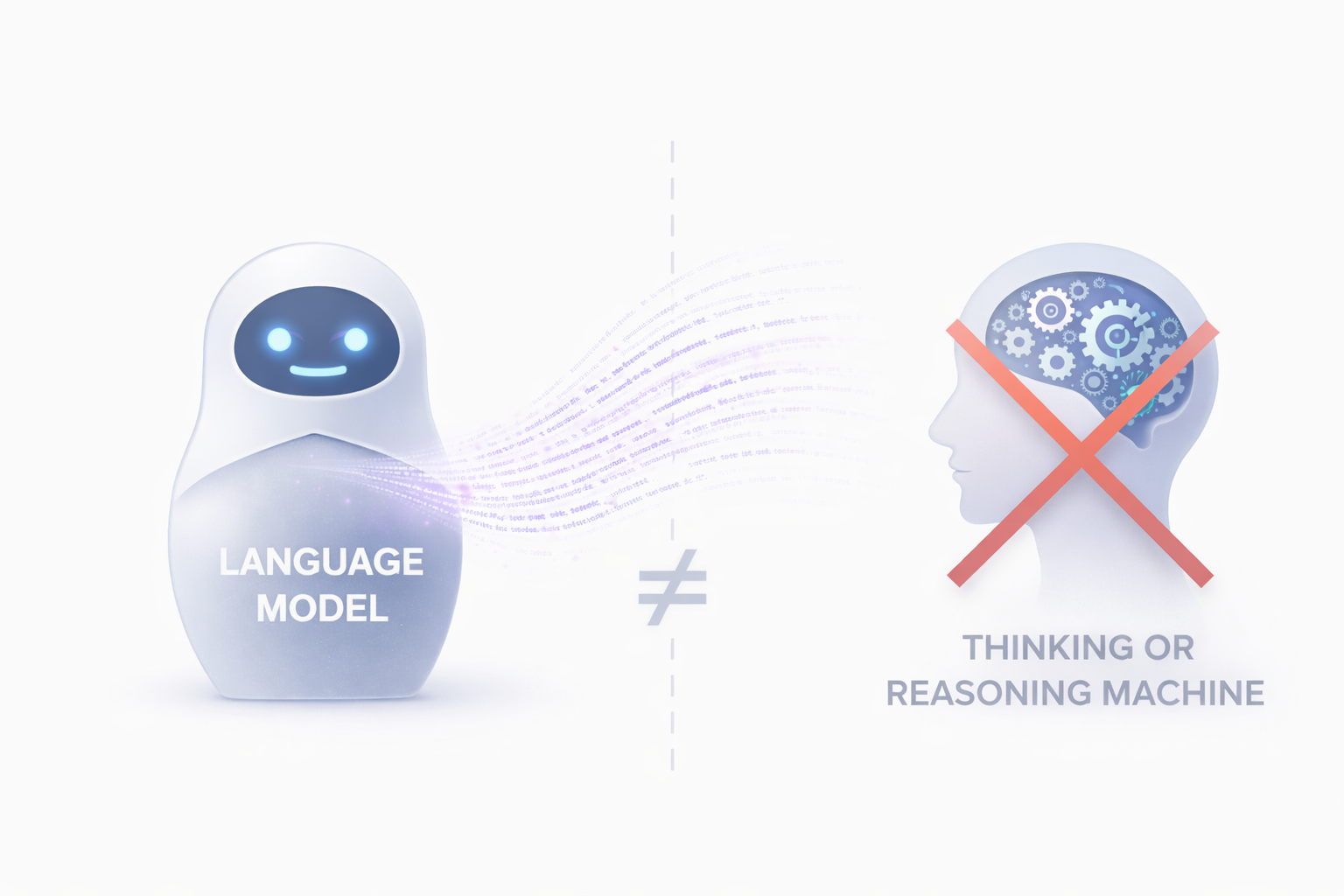
Language models are remarkable at producing text.
Fluency is not intelligence.
Reasoning requires structure, memory, and validation.
They sound confident — even when they are wrong.
They generate answers — even when the question is poorly formed.
ReasonOS exists to solve this gap.
What ReasonOS is
ReasonOS is not a chatbot.
It is not a prompt library.
It is not a thin wrapper around an LLM.
ReasonOS is a reasoning system —
an orchestration layer that governs how thinking happens
before language is generated.
ReasonOS abstracts over execution choices.
Depending on context, it can run on different language models,
leverage fine-tuned or domain-adapted systems,
and operate over vector databases or alternative retrieval layers —
while preserving a consistent reasoning process.
Core reasoning capabilities
These capabilities form a reasoning substrate — not a single product —
and can be composed into many different systems.
Retrieval-augmented reasoning
Knowledge is retrieved and shaped before reasoning begins,
allowing context and constraints to guide thinking —
not just decorate outputs.
Reasoning without context leads to confident hallucination.
Domain-adapted reasoning strategies
ReasonOS routes tasks to domain-adapted reasoning strategies,
optimized for specific cognitive work —
not generic language generation.
ReasonOS is a general-purpose reasoning platform —
designed to support structured thinking across many domains.
Logicos is one implementation of ReasonOS.
It translates the platform’s capabilities into a focused,
human-facing workspace for founders.
Founders are not the limit of ReasonOS —
they are an early proving ground.
ReasonOS is built to power any system where reliable reasoning matters.
Toward a personal cognitive operating system
ReasonOS is designed not only to reason correctly,
but to reason consistently over time — for a specific individual.
When identity, memory, and preferences are applied,
ReasonOS becomes a personal cognitive operating system —
a system that adapts to how someone thinks, decides,
and evaluates trade-offs.
This is not a chatbot or a second brain.
It is a structured cognitive partner —
one that evolves as your thinking evolves.
Over time, ReasonOS enables YouOS —
a persistent cognitive layer shaped by the individual.
Designed to outlive any single model or stack,
the system can reason across different language models,
fine-tuning approaches, and retrieval systems —
adapting to context while keeping reasoning disciplined and intact.
Built for the long term —
a foundation for reliable reasoning
in an increasingly automated world.